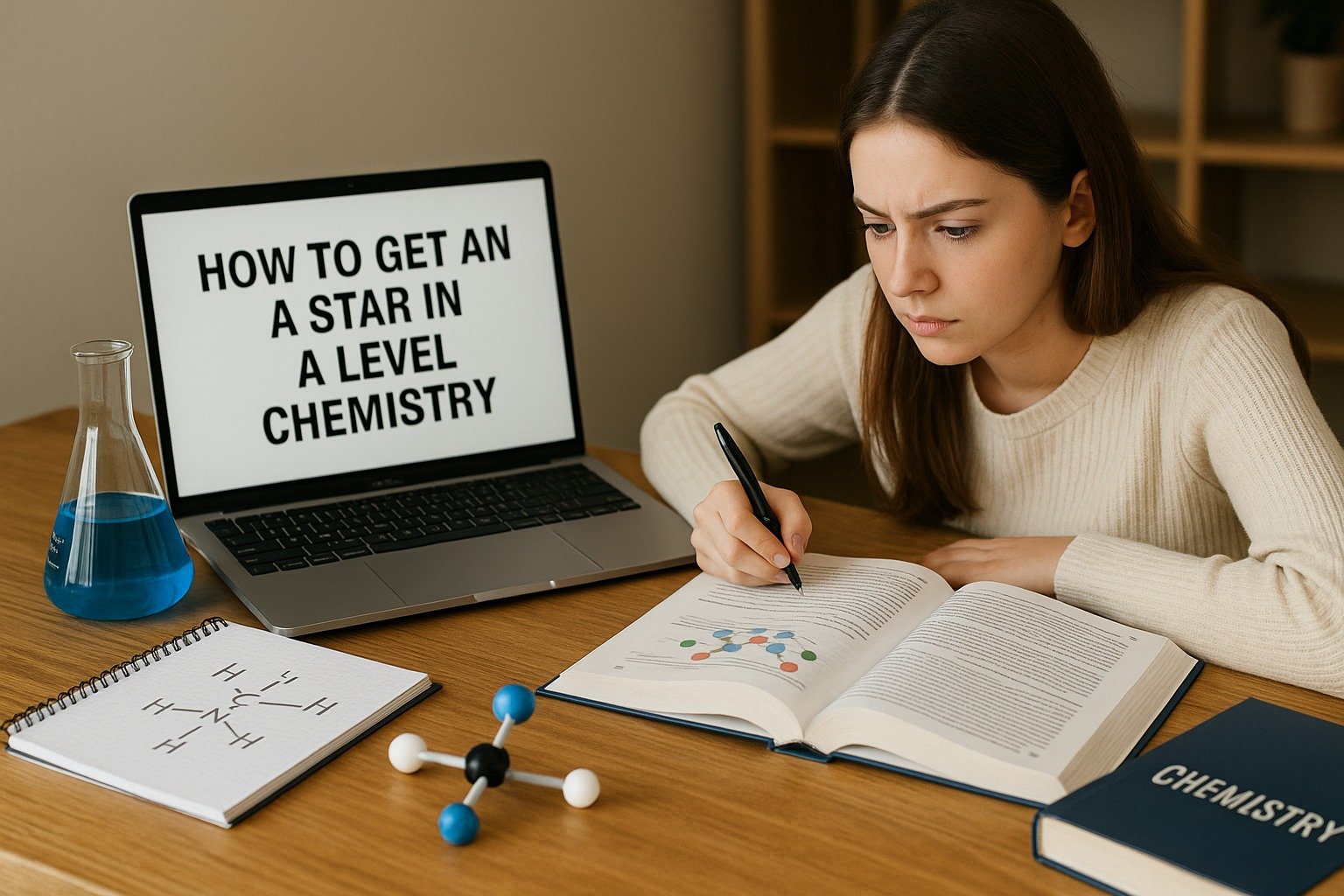
Getting an A Star in A Level Chemistry isn’t about being some lab-coat-wearing genius, it’s about mastering a system, understanding how examiners think, and playing a very specific game with precision and calm. The grade itself isn’t mysterious, it’s simply the by-product of hitting the top band consistently across papers, keeping silly mistakes to a minimum, and answering questions like someone who has already seen ten versions of them before. Chemistry doesn’t reward panic or cramming, it rewards clarity, structure, and confidence, something most teens don’t naturally have when facing enthalpy cycles and organic mechanisms.
To hit an A Star, a student needs deep understanding, not surface learning. They need to see patterns, not pages. They need the ability to move from one topic to another without breaking mental stride. And most importantly, they need to believe they can do it, because confidence in Chemistry is half the battle. Once the fog clears, progress speeds up beautifully.
The “Good but Not Great” Plateau
Every parent knows this stage. The student isn’t failing, they’re not struggling, but they’re not launching either. They float between B and A, usually because they’ve learned how to “remember” but not how to “understand.” Chemistry punishes memorisers, it rewards thinkers. It is the subject where tiny misconceptions turn into huge marks lost.
Memory vs Understanding
A bright student can memorise Le Chatelier’s Principle, but without real understanding, they crumble the second an unfamiliar twist appears in the question. Chemistry is a chain, and the chain is only as strong as its weakest link. Once one concept is misunderstood, everything built on top of it wobbles.
Chemistry is like learning a language with rules that change depending on context. Most students never get enough step-by-step guidance in school, simply because the class moves too quickly. One stuck moment stays stuck, and parents begin to notice the confidence dip.
Students focus on “getting through the work,” while mums focus on “getting ahead.” Tuition bridges that. It slows the rush, strengthens the foundations, and builds the kind of methodical confidence that transforms grades.
Emmanuel isn’t teaching from theory, he’s teaching from experience. He was the student who cracked the A Star in A Level Chemistry, the one who figured out what examiners actually reward. He knows the pitfalls, the traps, the common mistakes, and the sneaky patterns behind trick questions. Students respond to that because he speaks their language, but with the calm authority of someone who has already crossed the finish line.
Next Step Tuition isn’t a conveyor belt. It’s personal, it’s precise, and it’s built on the belief that every young person can think more clearly than they realise. Emmanuel shows them how.
The majority of brains learn Chemistry not by reading notes, but by seeing patterns, hearing explanations that make sense, and experiencing those “aha” moments. Emmanuel teaches in that rhythm. His style hits the natural pathways of understanding, so ideas stick without forcing them.
Confidence is the oxygen of academic performance. Once students feel like Chemistry makes sense, their performance leaps forward. Emmanuel’s approach activates that shift quickly and naturally.
A Star students don’t work harder, they work in a rhythm.
A rhythm of:
Before improvement, Emmanuel clears the clutter, correcting small errors that cause massive mark losses.
Once the foundation is strong, students train like athletes, practising paper styles until even tricky questions feel predictable.
Parents describe him as calm, thoughtful, and razor-clear. He teaches Chemistry like a story, not a struggle.
Starting in Year 12 is ideal, but even Year 13 students can make dramatic progress with the right guidance. The key is the plan, not the panic.
Next Step Tuition has seen C students rise to A Stars, shaky students become confident ones, and overwhelmed teens finally feel in control of a subject they once feared. Parents thank Emmanuel for the clarity he brings into their homes.
Q1: Does a student need straight A grades to get an A Star in Chemistry?
No, they need a smart system and consistent guidance.
Q2: Can a student go from a B to an A Star?
Absolutely, if misconceptions are fixed early.
Q3: How much weekly study is ideal?
Two to three focused sessions with structured revision.
Q4: Is Chemistry harder than other sciences?
It’s more layered, but not harder with the right help.
Q5: Why is Emmanuel so effective?
Because he understands both the student mindset and the examiner mindset.
Q6: Can tuition help even late in the year?
Yes, especially when the teaching style accelerates understanding.
📞 Call: 03333 356780
FREE TRIAL: old.thenextsteptuition.com/contact
Your child’s A Star journey starts with one conversation.